

Is Your AI Content Strategy Just Making More Noise?
Quick answer An AI content strategy that chases volume makes your company sound like everyone else. AI made posts cheap to produce, so publishing more no longer helps you stand out. What B2B buyers trust now is a clear point of view backed by real proof from your own work. Use AI to draft and reshape your content, but let your leaders decide what you believe and what you say.
An AI content strategy is your plan for how your company uses AI tools to make blog posts, social posts, emails, and videos. Here is the problem I keep seeing. AI made content easy to make, so now everybody makes a lot of it. When everyone can publish more, more stops being an advantage. It becomes noise.
If you run a B2B company doing $5M to $50M a year, this matters to you. B2B means you sell to other businesses. Your buyers read your posts and decide if you understand their problems long before they talk to your sales team. What I have found is simple. The companies that win will not publish the most. They will publish the most believable things.
- AI made content cheap, so volume alone no longer helps you stand out.
- The rare thing now is a clear point of view, not more posts.
- B2B buyers trust specific proof, like real numbers and real client stories, more than general tips.
- Use AI to draft, shorten, and repurpose. Do not let it decide what you believe.
- Three strong posts a week beat ten posts that sound like software.
- Measure replies, meetings, and deals. Not likes.
What Is Happening to B2B Content Marketing Right Now?
AI tools now write posts, edit videos, and fill a month of content in minutes. So almost every company is publishing more, and most of it sounds the same.
The numbers back this up. According to Ahrefs (2026), 93% of marketers now use AI to help create content, up from 87% the year before. That is close to everyone.
Creators are showing off big follower counts they built with almost no ad spend. Some of those stories are real, and some are impressive. But here is what it looks like from your buyer’s side. They open LinkedIn and see the same tone, the same hooks, and the same tips from everyone.
You probably feel the pressure to keep up. Your board asks about content. Your team says they need more tools. Someone suggests posting every day.
That feels like progress. Most of the time, it is not. I call it random acts of marketing. Lots of activity, and no strategy behind it.
Why Is a Point of View the Real Edge in an AI Content Strategy?
When content is cheap to make, the rare thing is a point of view. Buyers trust clear opinions backed by proof from people who have done the work.
Anyone can ask AI for a post called “Five Ways to Grow Your Pipeline.” Almost no one can say, “Here is what we saw across twelve client accounts last quarter, and here is the one thing that moved revenue.” That second sentence can only come from you. It comes from your calls, your clients, and your mistakes.
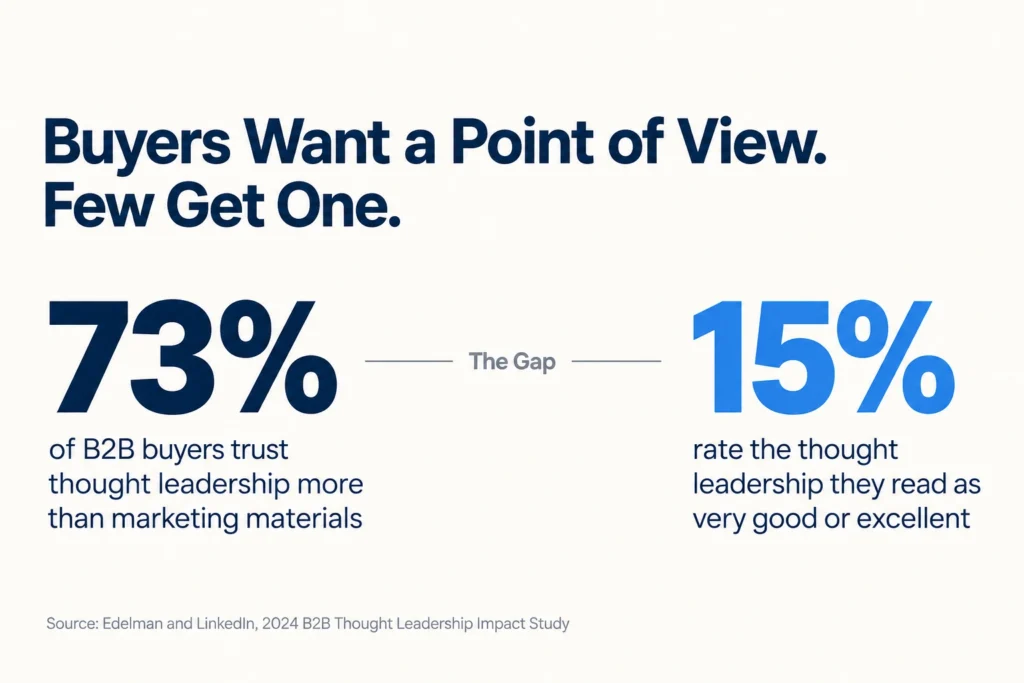
Buyers notice the difference. In the 2024 Edelman-LinkedIn B2B Thought Leadership Study of 3,500 decision-makers, 73% of B2B buyers said thought leadership is a more trustworthy way to judge a company than its marketing materials. But only 15% said the thought leadership they read is very good or excellent.
Read those two numbers together. Buyers want a strong point of view. Very few companies are giving them one. That gap is your opening.
AI is great at a first draft. But it has never sat across the table from your customer. That part has to come from you and your team. So the winners will not be the companies that publish the most. They will be the companies that publish the most believable things.
Does AI-Generated Content Hurt Buyer Trust?
Generic AI-generated content can quietly cost you trust. Many people trust a brand less when its content feels like a machine wrote it.
According to YouGov data reported by MarTech (2026), 32% of consumers said they would trust a brand less if they knew its content was AI-generated. Only 15% said they would trust it more.
Those are consumers, not B2B buyers. But the CEO reading your post is a person first. When something sounds like software, people notice.
Google is paying attention too. In October 2026, Google updated its Search Central guidance to say people should fact-check and review AI content before it goes live. That review covers page titles, meta descriptions, and even image alt text.
What Are the Signs Your Company Has a Content Volume Problem?
You have a volume problem if your posts could be swapped with a competitor’s and nobody would notice. If two or more of these signs sound familiar, adding more AI will just give you more of the same.
Signs of a content volume problem
Your posts could be swapped with a competitor’s, and nobody would notice.
Your team tracks posts per week instead of meetings booked.
Nobody can say what your company believes that others in your space do not.
Your best content always comes from one person, and everything else feels like filler.
Here is the pattern I see. Marketing activity does not necessarily mean marketing leadership. Someone on your team is producing content. But who owns the message? Who decides what your company believes?
If the answer is nobody, AI will fill that empty space with average ideas.
How Do You Build an AI Content Strategy Around a Clear Point of View?
Start with three big beliefs, collect real proof, and let AI do the heavy lifting. Then cut how much you publish and measure what a CEO cares about.
This plan fits a lean team. You do not need a big budget or a big staff.
1. Find your three big beliefs
What do you know about your market that most people get wrong? Write down three. These become the backbone of everything you publish.
2. Collect real proof
Gather numbers, client situations, and lessons from the last 90 days. Remove names if you need to. Specific beats polished every time.
Here is an example from my own work. Goelzer Industries is an envelope maker that had been in business 38 years. They had never run an ad, never sent an email, and never posted on social media. They lived on referrals until sales started to slip. Our work together led to $4.21M in attributable new revenue.
Notice how specific that story is. A CEO reading it knows right away if it sounds like their company. A list of tips can never do that.
3. Use AI for the heavy lifting, not the thinking
Let AI draft, reformat, shorten, and repurpose. Do not let it decide what you believe.
4. Cut your volume in half and raise the bar
Three strong posts a week that sound like a real person will beat ten that sound like software.
5. Measure what a CEO cares about
Track replies from the right people, meetings booked, and deals your content helped close. Not likes.
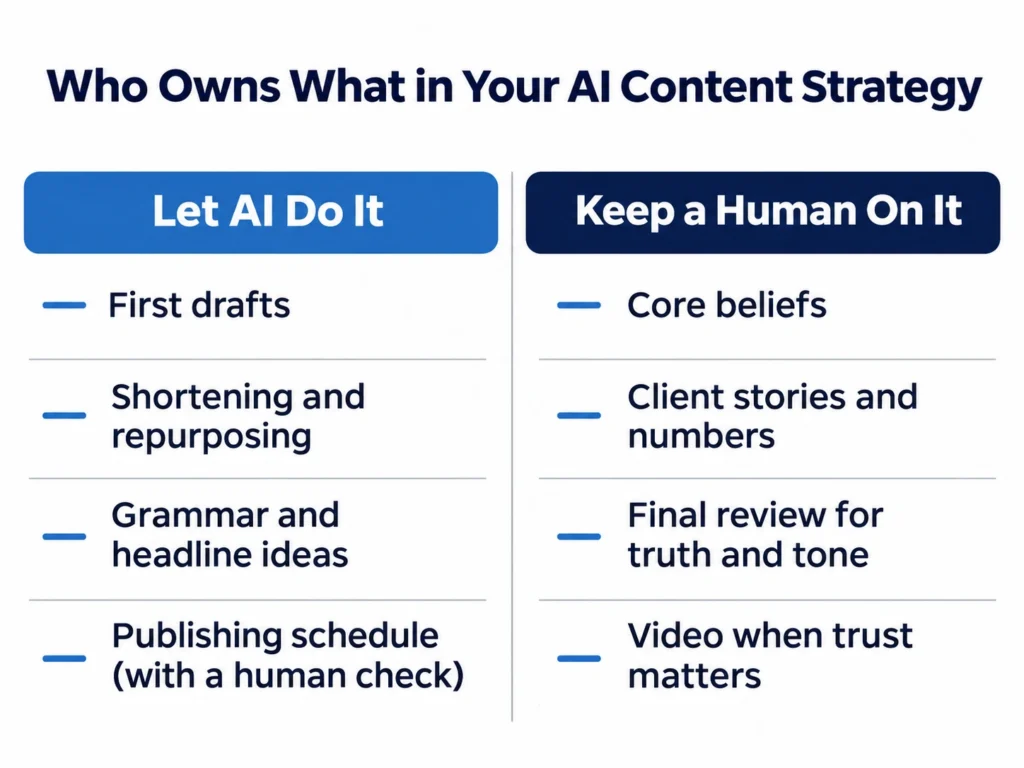
Who Should Own Each Content Task: AI or Your Team?
| Task | Best Owner | Why |
|---|---|---|
| Writing the first draft | AI | It turns rough notes into clean copy fast. |
| Shortening and repurposing | AI | One long post can become five short ones in minutes. |
| Grammar and headline ideas | AI | It catches mistakes and offers options quickly. |
| Planning the publishing schedule | AI, with a human check | It organizes well, but people set the priorities. |
| Choosing your core beliefs | Leadership | Only your leaders know what you stand for. |
| Client stories and numbers | Your team | AI was not on the call and does not know what happened. |
| Final review for truth and tone | A leader | This protects trust and catches errors. |
| Video when trust matters | A real leader on camera | Executives trust a real person sharing a real lesson. |
What Does a Simple Weekly Content Routine Look Like?
One leader records a ten-minute voice note on Monday, and the team uses AI to turn it into a week of content. The leader then spends about fifteen minutes checking it for truth and tone.
A Weekly Content Rhythm for a Lean B2B Team
| Day | Who | What Happens |
|---|---|---|
| Monday | One leader | Records a 10-minute voice note on what they saw in the market last week. |
| Tuesday | Marketing team, using AI | Turns the note into a blog draft, a few social posts, and an email. |
| Wednesday | The leader | Edits for truth and tone. This takes about 15 minutes. |
| Thursday and Friday | Team and leader | Publish, reply to comments, and note which topics started real conversations. |
Once a month, look at which beliefs got the best response. Then double down on those.
Where Does AI Fit in B2B Content, and Where Does It Not?
AI is excellent at shaping the raw material you give it. It is poor at knowing what is true in your market right now.
Let me be clear. I am not against using AI for content. I have used AI in my own business and for clients for more than four years. Most good marketers use it too.
AI is excellent at turning a rough idea into a clean draft. It can cut one long post into five short ones. It is good at fixing grammar, finding a better headline, and building a schedule.
But it does not know what your last client said on a hard call. It does not know which story your buyers still repeat a year later. So treat AI like a fast assistant. Give it your raw material and your opinions. Let it do the shaping. Then review everything before it goes out.
What about video?
Many creators use AI to grow big video audiences. That works for some brands, especially brands that sell to consumers. For B2B companies selling to executives, the rule is the same as everything else. A short video of a real leader sharing a real lesson will beat a polished AI clip with no point. Use AI to edit, caption, and repurpose. Keep the human on camera when trust matters.
More buyers now ask ChatGPT, Perplexity, and Gemini for answers before they ever visit your website. These tools look for clear, specific answers they can quote. A generic post gives them nothing to quote. A post with real numbers and a clear opinion does.
What Do B2B Buyers Actually Remember From Content?
Buyers remember a specific story, a surprising number, or a strong opinion. A list of tips almost never sticks.
Think about the last post that stuck with you. It probably was not a list of tips. Buyers are the same. A CEO reading your post is asking one silent question: “Does this person understand my situation?”
Specific details answer that question. Here is an example of the kind of sentence that works:
One line like that does more than ten general tips.
Collect those details as you go. Keep a simple running note of numbers, quotes, and lessons from client work. That note becomes your best content source, and no AI tool can build it for you.
How Do You Know If Your AI Content Strategy Is Working?
Give it 90 days and track three numbers. If they rise while your post count falls, you are on the right track.
Replies from target accounts.
Meetings booked that mention your content.
How often buyers bring up something you published on sales calls.
If those numbers stay flat, your beliefs may not be sharp enough yet. Go back to your three big ideas. Make them more specific and a little more bold.
Then ask your sales team which of your ideas buyers repeat. Their answer is worth more than any analytics report.
Why Should the CEO Own the Point of View?
The point of view has to come from the top, or from someone who speaks for the top. Buyers decide if you are believable through your content long before they talk to sales.
What happens a lot is the CEO hands content to the team and walks away. Then nobody is accountable for the message at the executive level.
A flood of generic posts quietly tells buyers you are one more option. A few sharp, specific ideas tell them you are the one who understands their problem.
The good news is that the CEO does not have to do it alone. Ten minutes on Monday and fifteen on Wednesday is enough to keep the voice real.
Frequently Asked Questions About AI Content Strategy
What is an AI content strategy?
An AI content strategy is a plan for how your company uses AI tools to create and share content like blog posts, social posts, and emails. A good one uses AI for drafting and repurposing. It keeps people in charge of what the company believes and what it says.
Is AI-generated content bad for B2B marketing?
No, but unedited, generic AI content can hurt trust. Buyers can tell when content has no real point of view behind it. Use AI to draft and reshape, then have a leader review every piece for truth and tone.
How many posts should a B2B company publish each week?
Quality matters more than volume. For most lean B2B teams, three strong pieces a week that sound like a real person will beat ten generic ones. Start there and adjust based on replies and meetings, not likes.
What is the difference between thought leadership and regular content marketing?
Regular content marketing often shares general tips that anyone could write. Thought leadership shares a clear point of view backed by your own experience and proof. B2B buyers trust thought leadership more because it shows how your company actually thinks.
How long does it take for an AI content strategy built on a point of view to work?
Give it about 90 days. Track replies from target accounts, meetings that mention your content, and how often buyers bring up your ideas on sales calls. If those numbers rise, it is working.
Should a CEO write their own content if AI can do it?
The CEO does not need to write every word, but the point of view should come from the top. A ten-minute weekly voice note and a fifteen-minute review are often enough. AI and the team can handle the rest.
How do I get my content to show up in ChatGPT and other AI answers?
AI answer engines look for clear, specific, trustworthy answers they can quote. Use question-style headings, put a direct answer right under each heading, and include real numbers with sources. FAQ schema and other structured data also help these tools read your page.
What should I measure instead of likes?
Measure what a CEO cares about: replies from the right people, meetings booked, and deals your content influenced. Also ask your sales team which of your ideas buyers repeat. Those signals show real interest, not just attention.
Final Thoughts
An AI content strategy that chases volume makes you sound like everyone else, while a clear point of view backed by real proof makes you the company buyers remember.
Here are three things you can do this week:
- Pull up your last ten posts and cover the logo. Would a buyer know it was you?
- Write down three beliefs your company holds that most of your market gets wrong.
- Start a running note of real numbers, client stories, and lessons. Add to it every week.
Luce Media (lucemedia.net) is a McKinney, Texas marketing agency that provides fractional CMO strategy and AI visibility services to B2B companies generating $5M to $50M in annual revenue. I always lead with strategy, and this is a strategy problem before it is an AI problem.
- Ahrefs, State of AI Content Marketing 2026 survey (published Sept. 30, 2026), as reported by Relevant Audience
- Edelman and LinkedIn, 2024 B2B Thought Leadership Impact Study
- YouGov 2026 consumer data, as reported by MarTech
- Google Search Central, guidance on using generative AI content (updated Oct. 1, 2026)
Schedule a Strategy Call
If this sounds familiar, you are not imagining it. If you would like a second set of eyes on your content and the beliefs behind it, schedule a strategy call with our fractional CMO team at cmoadvisers.com.
Schedule a strategy call